For decades, there was a clear line in the sand between “Junior” and “Senior” communication. Juniors gathered data and waited for instructions. Seniors provided the context, the options, and the path forward. High-level strategic decision-making was a luxury reserved for the boardroom – a vertical, static structure where information flowed up and decisions flowed down.
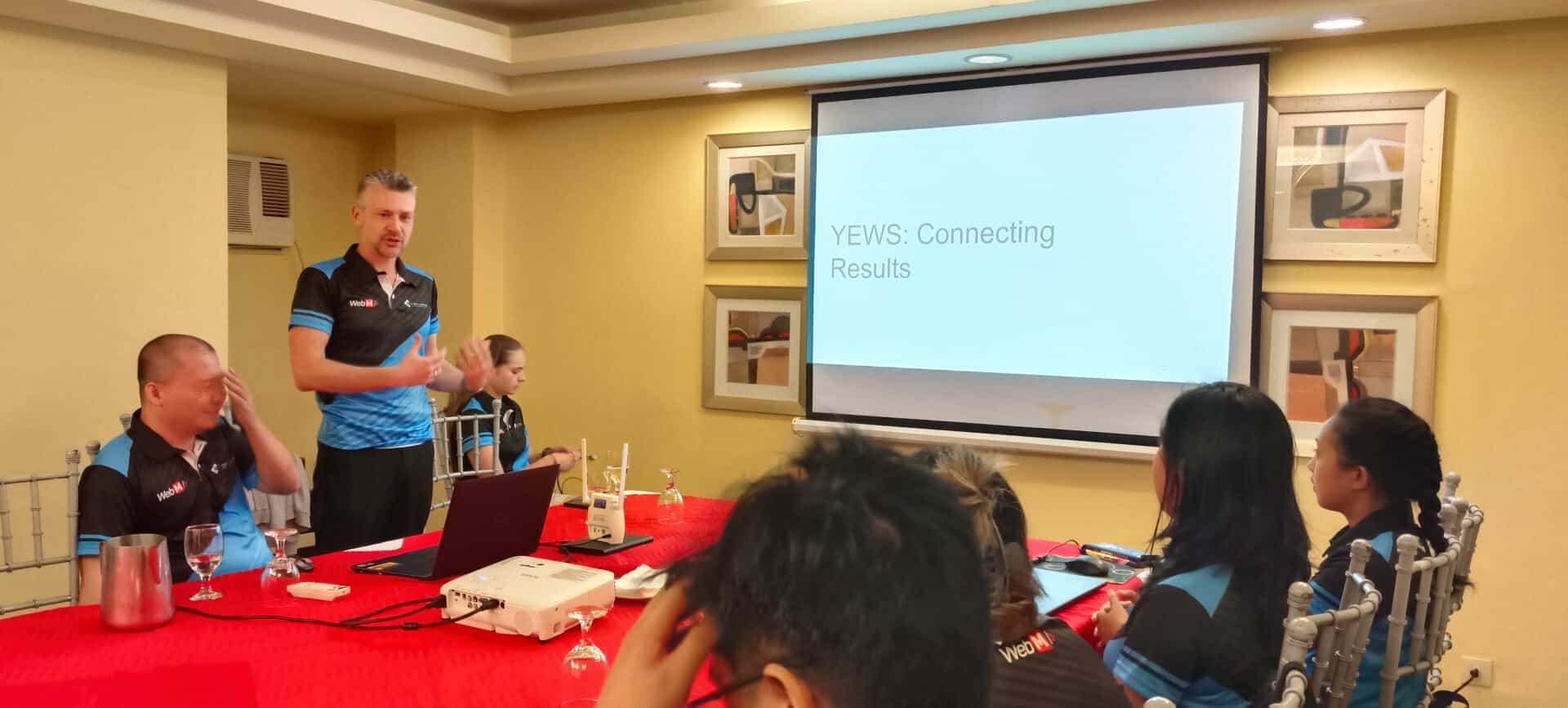
Decision Architecture in practice: Leading the teams at YEWS and WebM through the evaluation process – moving beyond data gathering to trigger expert-vetted actions.
In 2026, we are witnessing a fundamental paradigm shift. What was once static is becoming dynamic. The rate of change in our industry has accelerated to a point where the traditional “top-down” model can no longer keep pace with the constant flux of the market. To stay relevant, we have to recognise that while change has always been around, its frequency has now made “static” roles obsolete.
Because of AI, high-level information and strategy have become commodities. When everyone has access to a “perfect” plan, the plan itself is no longer the differentiator. The real competitive advantage has shifted to the ability to evaluate the noise and trigger the right action. This is where Human Prompting becomes the essential skill for the modern leader.
I’ve seen this shift firsthand while leading our teams through complex technical hurdles; it’s no longer about who has the data, but who has the clarity to use it.
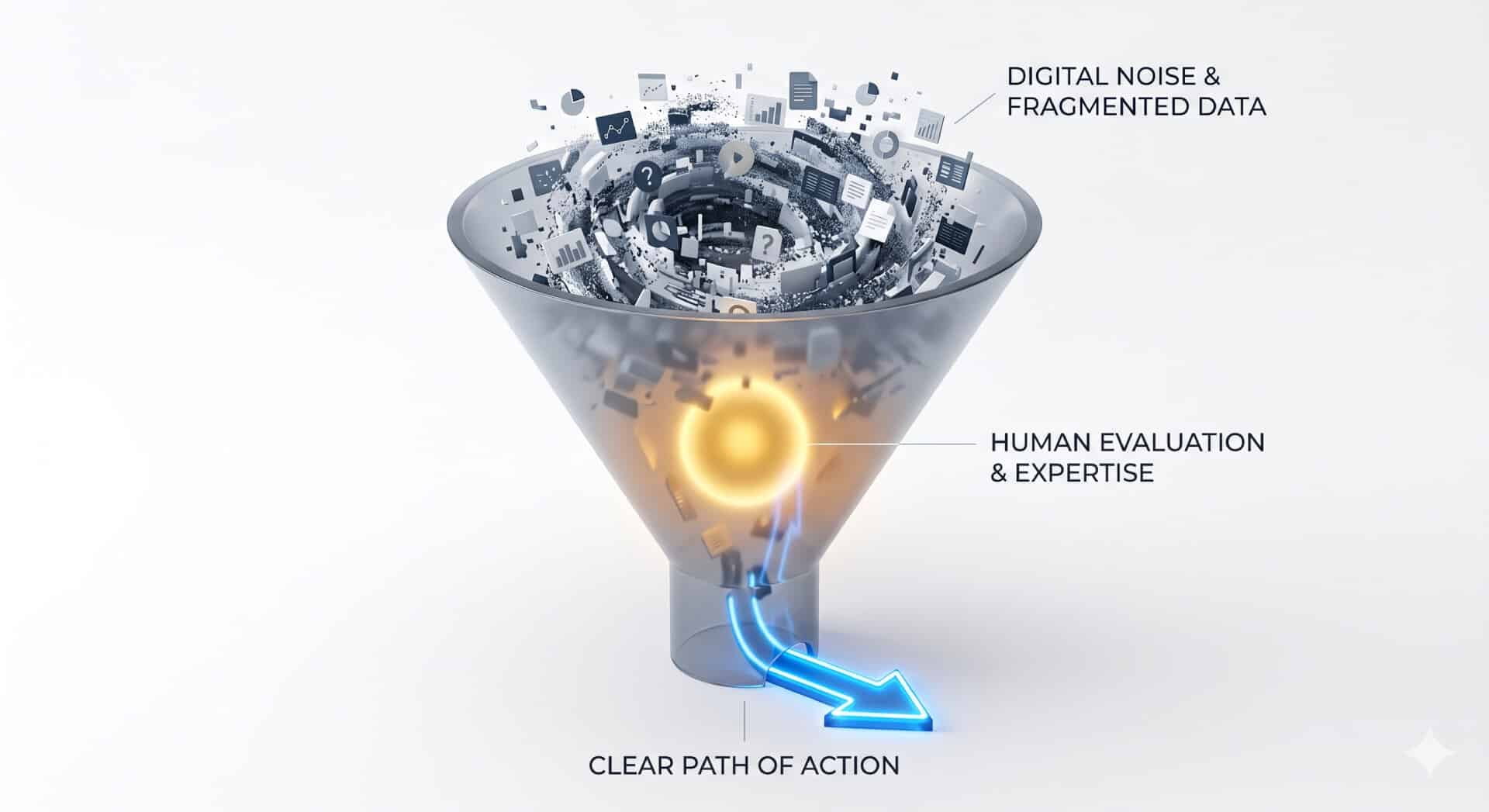
The Human Prompt as a Filter: Turning a commodity of information into a catalyst for execution.
I. The Anatomy of a Decision Trigger
It is a common mistake to think that “prompting” another human is simply asking them a question. In a world of infinite noise, asking a client or a team member to “do their own research” is just adding to their burden.
Human Prompting is a Decision Trigger. It is the act of doing the research, the analysis, and the evaluation yourself – leveraging your Digital Core and AI tools to do the heavy lifting – and then communicating the result in a way that enables the other person to make a decision instantly. You aren’t asking them to do the work; you are presenting them with a finished path so they no longer have to waste their most valuable resource: time.
II. The Decision Architect’s Toolkit
To move from a “Standard” request to a “Human Prompt,” you must do the heavy lifting of evaluation before you hit send. Here is how that looks in four common scenarios:
Standard Requests vs. The Human Prompt
1. Assigning a Team Task
- The Standard: “Can you look into the tracking issue on the checkout page and let me know what you find?”
- The Human Prompt: “The checkout tracking is dropping off at the payment step. I’ve narrowed it down to a script conflict or a cookie mismatch. Spend 30 mins testing the script first – if that’s the fix, go ahead and deploy. If not, let’s pivot to the cookie theory at 2 PM.“
2. Client Platform Choice
- The Standard: “Here are three different CRM options that integrate with your site. Have a look and let me know which one you prefer.”
- The Human Prompt: “We’ve audited three CRMs. Based on your current lead volume and the need for Autonomous Lead Rescue, Path A is the only one that scales without breaking your budget. Path B is cheaper but lacks the API depth we need. Do you want me to trigger the setup for Path A today?”
3. Junior Reporting to Senior
- The Standard: “The client is asking why the newsletter didn’t go out. What should I tell them?”
- The Human Prompt: “The newsletter was delayed due to an API timeout. I’ve already drafted an apology to the client and scheduled the send for 9 AM tomorrow when traffic is lower. Does that approach work for you?”
4. Partner Collaboration
- The Standard: “We’ve finished the creative assets. How do you want to handle the technical implementation?”
- The Human Prompt: “The creative assets are ready. We’ve reviewed the technical specs and prepared two implementation paths: a ‘Quick-Win’ embed or a ‘High-Performance’ custom API build. The API build takes two extra days but doubles the site speed. Given the launch deadline, which path do you want us to execute?“
These scenarios illustrate a fundamental shift in the definition of ‘expertise.’ In the past, being an expert meant having the answer. In 2026, being an expert means having the judgment to filter ten possible AI answers into one actionable path. But this level of precision isn’t free; it requires a specific internal standard that goes beyond just ‘using the tools’ effectively.
III. Rising Above the Baseline: The Pursuit of Excellence
This approach requires a commitment to not settling for the bare minimum. While AI can provide an “average” solution in seconds, the average is no longer enough to win. To provide a true Human Prompt, you must rise above the baseline of “good enough.”
This requires:
- Deep Trust: The person receiving your prompt must trust that you have done the rigorous work behind the scenes. They are trusting in your Expertise and Reliability.
- Eliminating Cognitive Load: You don’t present problems; you present solved scenarios. Your goal is to make the decision as easy as possible for the other person.
- Responsibility: You take the risk of the research so they can take the power of the decision.
When an individual adopts this mindset, they become a high-performer. But for a business to scale in the age of AI, this can’t just be the habit of a few top-tier directors. It has to be baked into the organisational chart. To reach the speeds required by the modern market, we had to rethink how ‘seniority’ actually functions within our walls.
IV. The Distribution of Senior Thinking
At YEWS, our Director, Alexei, has pioneered a horizontal, hybrid organisational structure. In this fluid environment, the traditional “Manager” is replaced by the “Enabler.” Management’s role is no longer to hold all the answers. Our role is to provide the context and the expert framework that allows others to step up. Every member of our team – from the most junior to the Director – is now expected to be a Decision Architect.
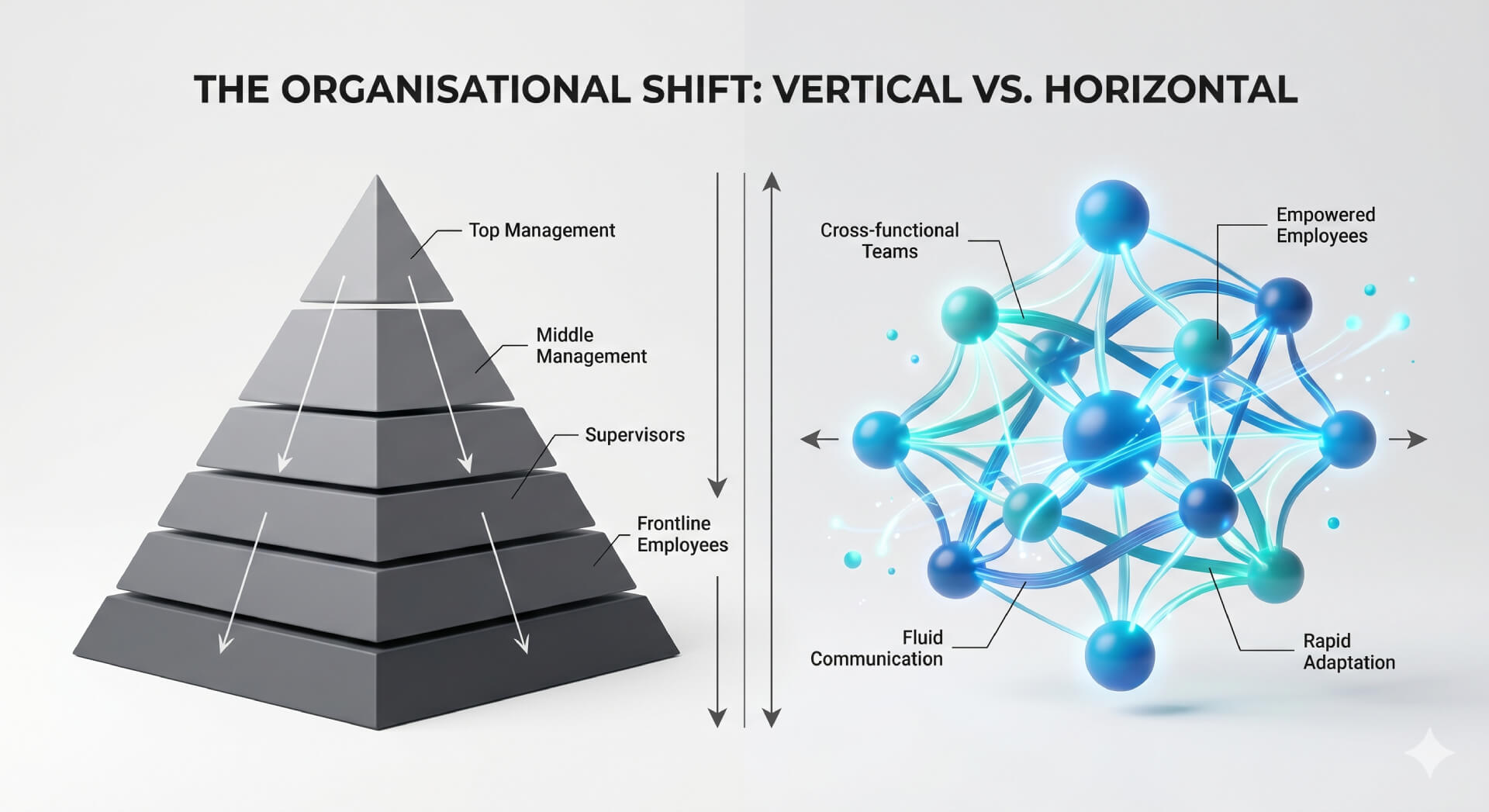
Moving from a static hierarchy to a dynamic network: Why the ‘Enabler’ model beats the ‘Manager’ model in 2026.
To see how this looks in practice, we look at it through three different lenses:
- 1. The Internal Lens: Enabling High-Performance: I recently presented a complex technical problem to a team leader. I “Human Prompted” them by defining the outcome and giving them the authority to own the resolution. They used AI to amplify their skills, addressed the entire Time to Resolution (TTR) loop themselves, and presented me with a result, not a question.
- 2. The Client Lens: The Technical Decision Architect: I look at the commodity data and filter it through our institutional experience. I do the hours of research so the client can spend thirty seconds making a confident decision.
- 3. The Partner Lens: The Agency’s Technical Expert: WebM often acts as the “How” for creative agencies. We step in with a Human Prompt that challenges the commodity, providing the technical insight and the pre-vetted action plan that cuts through the sameness of generic AI solutions.
Whether we are looking through an internal, client, or partner lens, the objective of a Human Prompt remains the same: to remove the friction of indecision. When you eliminate the ‘back-and-forth’ of low-context communication, you unlock the most valuable byproduct of modern strategy – Momentum.
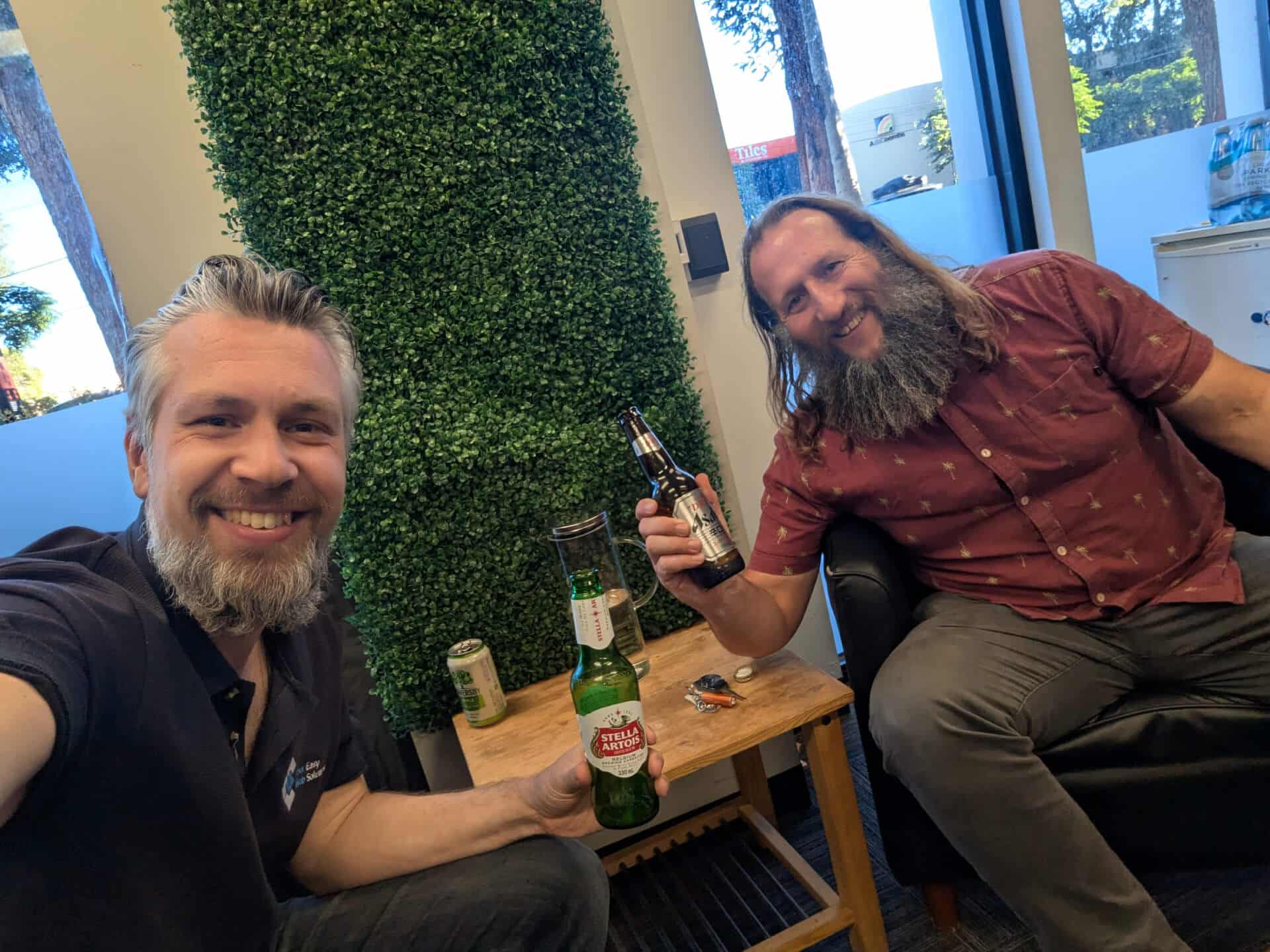
Substance and Trust: Grigory and Luke (Client Success Manager) at our Melbourne office. The strongest ‘Digital Core’ is still built on real human relationships and a shared cold beer.
V. TTR: The Metric of Momentum
Your differentiator is your Momentum. Time to Resolution (TTR) is the result of good Human Prompting. Internally, it allows our team to cut through paralysis and start executing. Externally, it allows our partners to move forward with confidence.
When you trust in the human aspect – when you refuse to settle for the average and instead provide true decision architecture – the “Sale” becomes natural. We aren’t just selling a service; we are selling the gift of clarity.
My final prompt to you is this: In your next meeting or email, don’t just provide an update. Provide a path. In 2026, the person who provides the clearest path is the person who wins.