
The WebM Standard in every detail: The difference between an automated output and an expert resolution is the same as the difference between a sachet and a specialty pour – substance is non-negotiable.
In Melbourne, we have a reputation for being snobs about our coffee. We understand that a real flat white requires a specific grind, a calibrated machine, and a barista who understands the physics of the pour. You can buy “instant” packets that claim to be just as good, but they are a commodity – a quick fix that lacks the substance of the real thing.
The digital world in 2026 is currently being flooded with “instant” expertise.
With AI, anyone can generate a smart-sounding strategy or a flashy website layout in seconds. The barrier to entry for appearing “capable” has never been lower. But as I look toward our 20th year at YEWS, I’ve realised that while the tools of the trade change, the value of an expert who can actually finish the job never does.
In our world, the most critical differentiator is Time to Resolution (TTR). It isn’t just about how fast you can respond; it’s about the distance between a problem being identified and that problem being dead and buried.
The Anatomy of the “Anxiety Gap”

Shortening the distance: A visual representation of the WebM workflow – using technical precision to cut through digital entropy and reach a definitive finish line.
For any business or worker, TTR is the definitive metric to measure trust. It addresses the “Anxiety Gap” – the period of uncertainty between a client, team member, or partner reporting a friction point and the moment they feel the relief of a resolution.
A simple example is a technical issue with a website that a client cannot solve themselves. TTR measures how long it takes to finally resolve that issue for good. If the same problem resurfaces, you haven’t achieved resolution; you’ve simply achieved a delay. Achieving a lower-than-expected TTR is the most effective way to grow trust. While your competitors are busy providing “updates,” you are providing a finish line.
The “Catch-Up” Trap vs. The Pioneer Edge
AI has become the great equaliser. If you are behind, you can use AI to “catch up” to the industry average almost instantly. But catching up to the average doesn’t give you a competitive advantage; it just keeps you in the race.
The true leaders – the pioneers – are those who use AI to move beyond the baseline. When everyone has access to the same AI-driven ideas, the differentiator becomes the human who can oversee the machine. AI might soon be able to diagnose a symptom and suggest a cure, but it cannot take Responsibility.
If an AI-administered solution fails, who manages the risk? Who handles the quick secondary resolution? This is where the human expert shines. We don’t just use the tool; we insure the outcome.
The WebM Standard
Our WebM head office is based in Moorabbin. Out here, surrounded by factories and trades, you don’t call a committee when a production line stops; you call someone with the specific know-how to get it moving again.
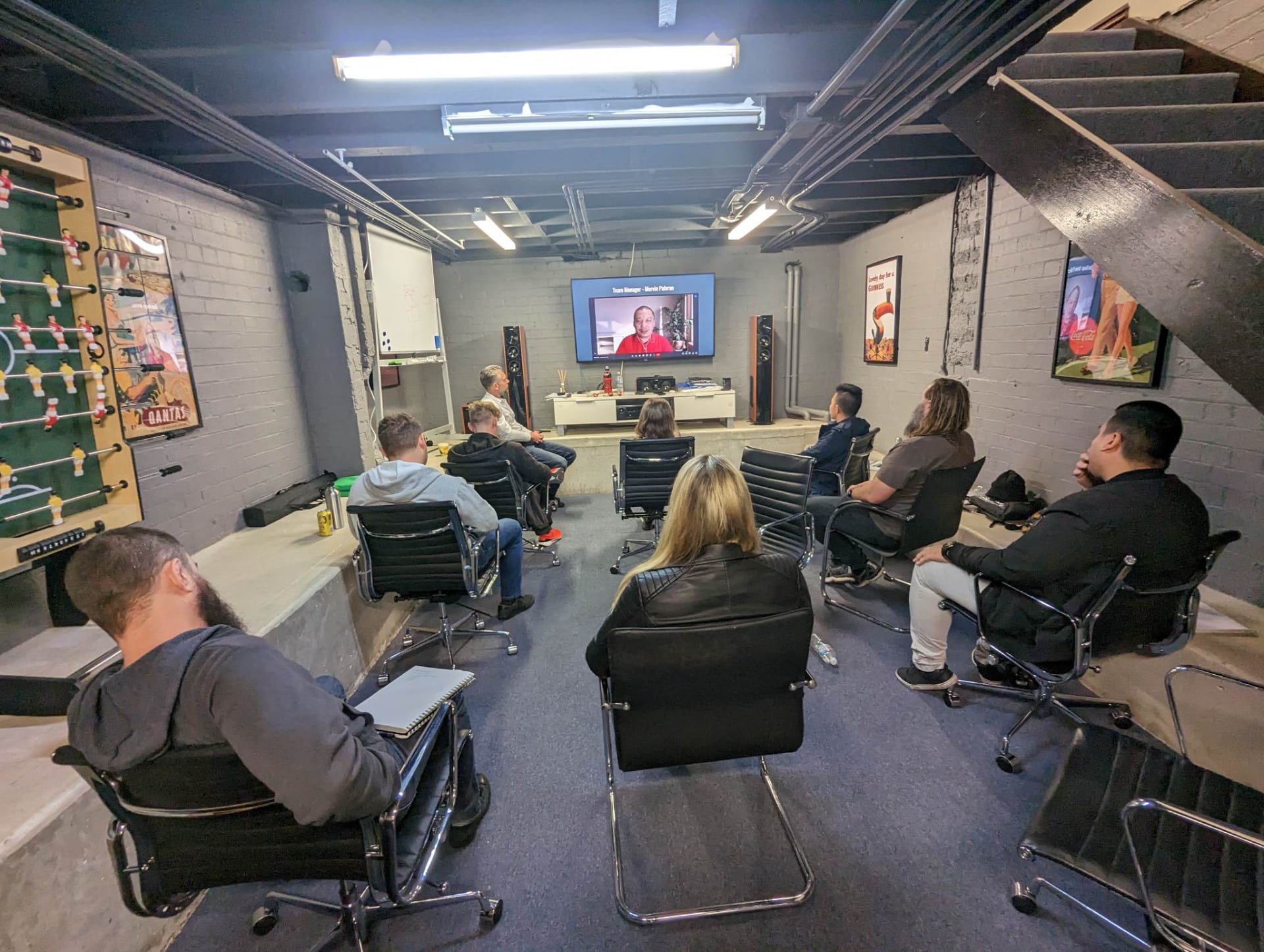
The Engine Room: Our local team in session. In a world of remote ghosting, we prioritise a localised “war room” environment to guarantee accountability.
My Russian Orthodox background has given me a deep respect for this kind of responsibility – the idea of taking personal ownership of the outcome. At WebM and YEWS, we maintain an in-house team for exactly this reason. When we speak to a partner or a client, there is no “outsourced” layer to hide behind. TTR is shortened because the people diagnosing the problem are the same people executing – and guaranteeing – the fix.
Coupled with our AI Policy, you can see the path we are setting for ourselves.
Deciphering the Actual Problem
A massive part of optimising for TTR is the human ability to recognise that the client’s perceived problem is often just a symptom. AI is excellent at solving the symptoms you give it; humans are required to find the cure and authorise the risk.
Deciphering the actual problem is a form of Human Prompting (as I discussed in my previous piece). It’s about doing the heavy lifting of evaluation – finding the ‘Cure’ rather than just treating the ‘Symptom’ – to reduce the cognitive load on the client.

Architecting Clarity: The Digital Core acts as the stage for human intuition – filtering out the “Time Tax” so strategic decisions can be made on a foundation of clean data.
Example: The Revenue Rescue
A client recently approached us convinced they needed a total website rebuild. They’d spent a significant amount of time looking at AI-generated designs and felt overwhelmed, unable to make a decision.
The Resolution: Instead of a long, standard rebuild, we used Human Prompting to redirect the strategy. We used AI to rapidly prototype precision-engineered landing pages and identify specific conversion conflicts that were hidden in the data. We resolved the actual pain point – the lack of leads – in a few days. This didn’t just help the client’s bottom line; it helped their GEO (Generative Engine Optimisation). We improved their digital authority in the AI ecosystem.
Example: The “Time Tax” Resolution
We worked with another company whose team spent a huge portion of their week manually updating seasonal promotions across multiple platforms. They thought they had a workload problem.
The Resolution: We saw it as a technical friction problem. We wrote custom scripts and set up an automation within their Digital Core. Now, those changes happen on a schedule – set and forgotten. We resolved the problem permanently, allowing their team to focus on high-value strategy instead of manual grunt work.
The Resolution Trust Equation
In professional services, we often look to the classic Trust Equation. But in 2026, the speed of technology has changed the math. I view it through this lens:
The Trust Algorithm
Trust = ( Expertise + Reliability ) / Self-Interest
When we use AI to solve a problem in an hour that used to take ten, a business focused on self-interest might still try to bill for ten. A business focused on Resolution delivers the fix in one. By choosing a lower TTR, we are effectively lowering the “Self-Interest” variable.
This is how we build long-term momentum and teach the new AI search engines (AEO/GEO – where AI answers questions directly rather than just providing links) to trust us. The machines are learning that we are a “Source of Truth” because we consistently provide definitive outcomes and take responsibility for results. This is reflected in the public ledger of reviews – the ultimate proof that your TTR isn’t just a claim, but a delivered promise.
This algorithm is the result of the Humanity Signal in action. When we use our Digital Core to handle the volume, we reclaim the time to focus on what matters: the Expertise and Reliability that drives a resolution.
Conclusion: The Amplified Craftsman
There is a lot of talk about AI replacing humans. But I see AI as the ultimate power tool; it doesn’t replace the craftsman, it amplifies them. An expert with AI can now achieve in a day what a team used to achieve in a month.

The Ultimate Premium: Closing the Anxiety Gap happens across a table, not just a ticket queue. True resolution is built on the proximity of a trusted partnership.
However, the tool still needs a hand to steady it. While AI can generate options, it cannot take Responsibility. It can suggest a path, but it cannot guarantee the Resolution.
Whether you are a junior staffer or a CEO, the question for 2026 is: Are you using these tools just to keep up with the noise, or are you using them to shorten the distance between a problem and its permanent fix? The plan is the floor, but Time To Resolution is your ultimate competitive advantage.
I invite you to look at your most recent client interaction. Was there an Anxiety Gap? Did you provide an update, or did you provide a Resolution?
If you’re ready to stop ‘catching up to the noise’ and start building a Digital Core that amplifies your own Humanity Signal, let’s have a coffee. A real one.