In 2026, we have reached the zenith of the Efficiency Paradox.
We are surrounded by tools that can generate a thousand words in a second, resolve a technical ticket in a millisecond, and automate an entire sales funnel with a single click. Yet, despite this infinite efficiency, something is missing. Businesses are becoming faster, yes, but they are also becoming colder and distant. They are louder, but they are harder to find.
I’ve realised that the greatest challenge of our time isn’t learning how to use AI. It’s learning how to synergise with AI to enhance our uniqueness, our strengths, our intuition.
We must use AI to handle the volume so that we can reclaim the time to be truly present. Looking back at the Melbourne city skyline from across the water, it becomes clear: the greatest challenge isn’t mastering the machine, but ensuring the machine buys us the freedom to be uniquely, authentically human.
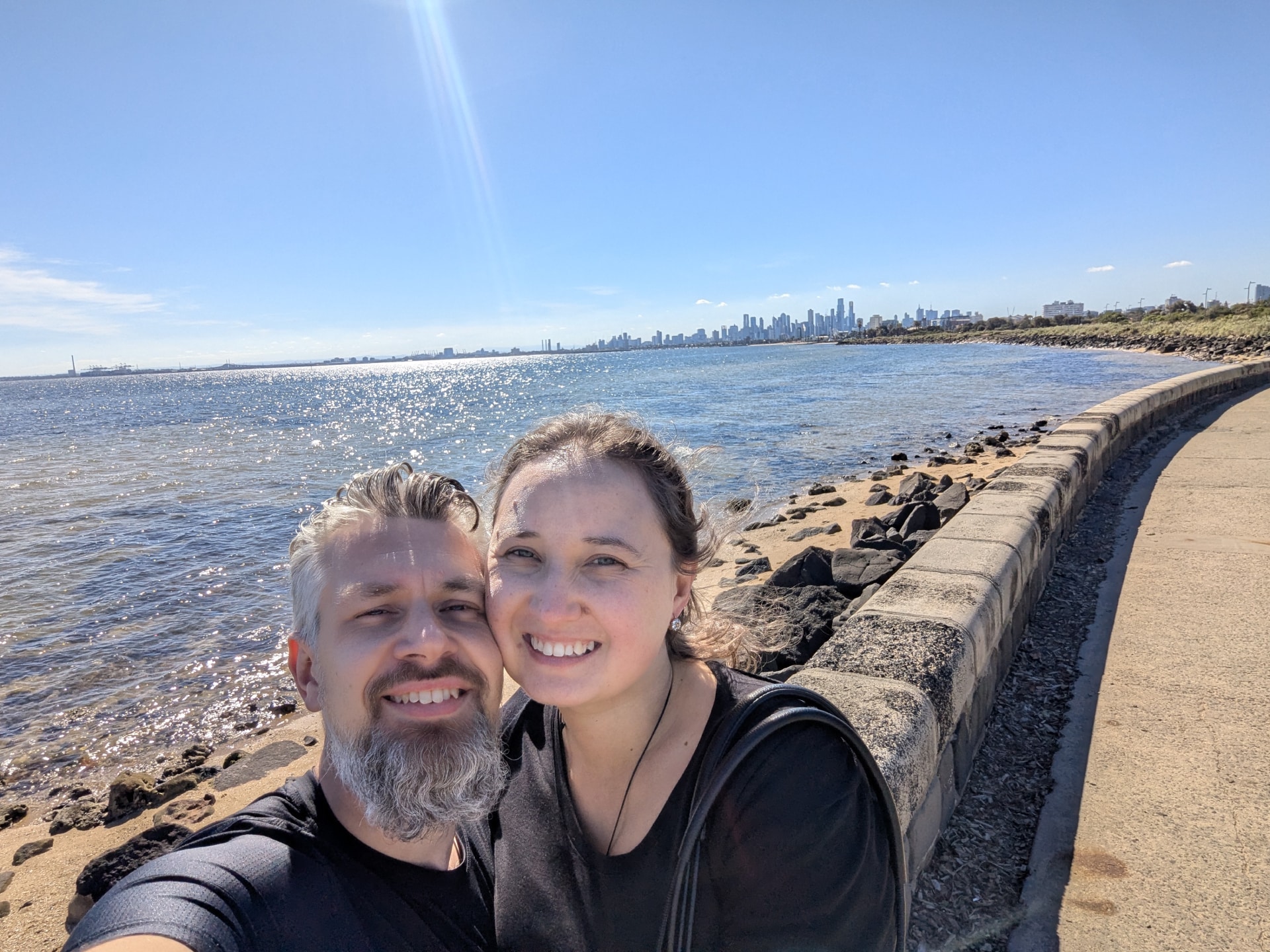
The Melbourne skyline represents the efficiency of the Digital Core; the moments on the sand represent why we build it. This is me and my wife, finding the ‘Humanity Signal’ on the shores of Port Phillip Bay.
This paradox isn’t just a high-level strategic concern; it is visible in the smallest, most overlooked real estate of our daily business lives. To understand how we lost the signal – and how we’re reclaiming it – we have to look at the ‘fossil record’ of our own communication: the humble email signature.
I. The Silent Crisis: The Efficiency Paradox
If you look at the evolution of our agency’s email signatures, you can see the history of the digital age written in the footer of a message.
In 2022, our signatures were digital billboards. They were loud, crowded with “ad reels,” multiple banners, and a laundry list of every service we offered. It was the era of “shouting” for attention.

The Billboard Era: High noise, low signal. We were shouting at the client, hoping something would stick.
By 2024, we overcorrected. We moved to a minimalist, highly functional, but ultimately cold and formal standard. It was efficient, but it lacked a pulse.

The Formal Era: Clean, but cold. We removed the noise but also removed the human behind the keyboard.
In 2026, we have reached the next stage: The Humanity Signal.
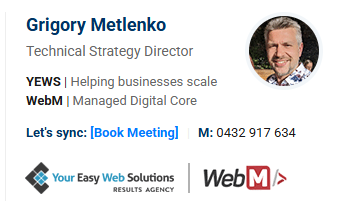
The Humanity Signal: Minimalist, personal, and high-trust. Prioritising the face and the direct connection over the advertisement.
Today, my signature — and the standard I set for my teams at YEWS and WebM — is built on the principle of presence. We’ve stripped away the noise to highlight a professional, circular headshot and a direct path to a human conversation. In a world where every “Content Assistant” can write a polite email, a human face and a clear “Book a Meeting” link have become the ultimate trust signals. We are no longer using the signature to sell; we are using it to prove that there is a real expert behind the screen. The 2026 version isn’t just “nicer” — it’s a deliberate Human Prompt. By stripping away the banners, you are giving the reader only one choice: to engage with you.
It might seem small — but even only after a week of usage, I was able to track a significant increase in engagement (booked meetings, communication, decision making).
Many leaders fear that being ‘less corporate’ means being less professional. Our data shows the opposite. By using UTM tracking within our minimalist signatures, we can see exactly when a human connection turns into a strategic meeting. We don’t guess; we measure.
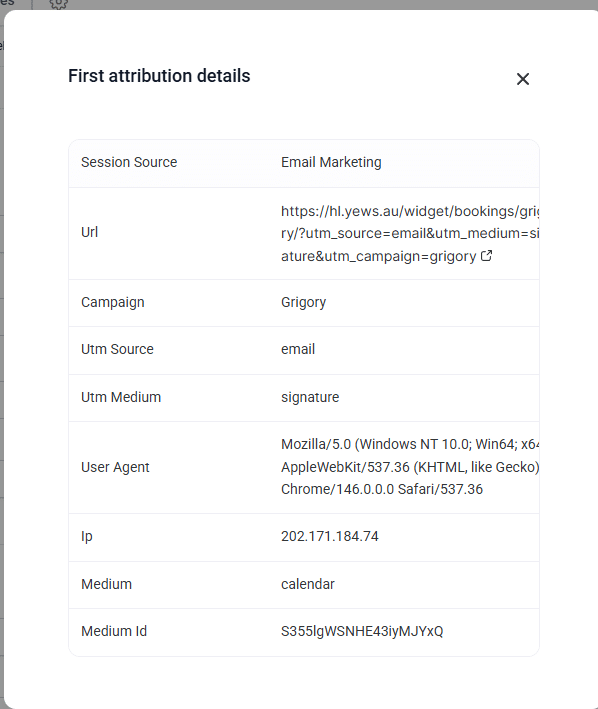
Closing the Loop: Real-time UTM attribution showing the direct ROI of a human-centric email signature. When we make it easier for people to connect, they do.
But a high-trust signature is merely the symptom of a deeper health. You cannot broadcast a clear ‘Humanity Signal’ if your team is drowning in technical debt, manual data entry, or fragmented systems. To allow the human face to shine, the technical background must be silent. This requires moving beyond ‘stacking tools’ and into building a unified foundation.
II. The Digital Core: A Stage, Not a Shield
To allow this “Humanity Signal” to be heard from a marketing perspective, we need a foundation. At WebM, we call this the Digital Core.
To be clear: the Digital Core is not just a “system.” It is the technical foundation specifically designed for marketing / advertising — ensuring your brand is seen, found, and heard. It is the architectural integration of your website, your CRM, and your e-commerce engine. It is the invisible web of APIs, automations, and processes that allow a business to breathe… or simply put, how all your tools talk to each other.
Many agencies and clients use their technical stack as a shield — a way to hide from the client behind chatbots and automated reports. I view it as a Stage.
The purpose of a perfectly architected Digital Core is to handle the “noise” (the spam, the broken data, the 24/7 status updates) so that the human strategist is free to perform. When the tech is working perfectly, the human expert doesn’t have to act like a machine. They can act like a partner.
This visualisation provides a clear map for what we are building.
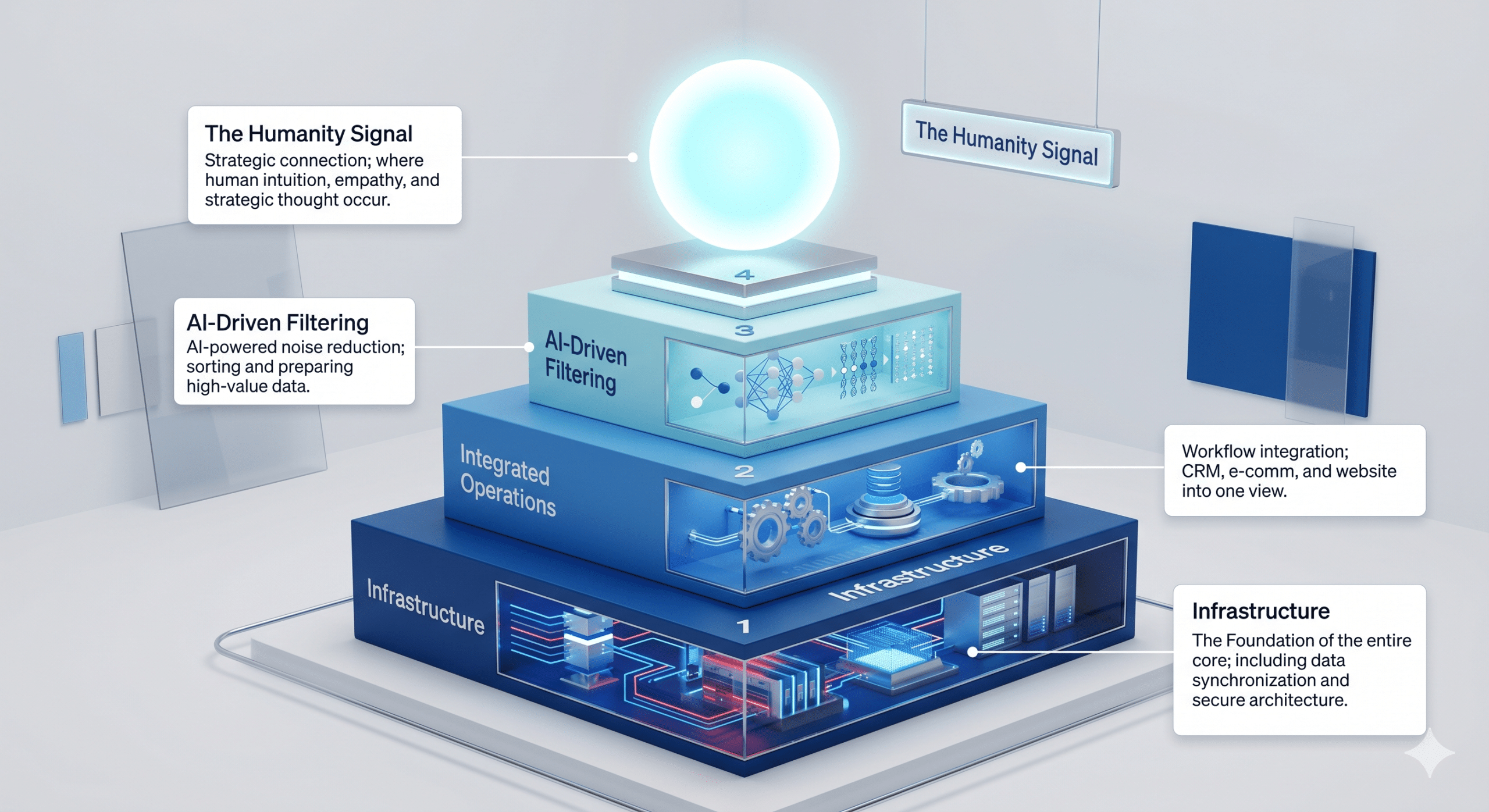
The Digital Core Architecture: A 4-layer foundation showing how secure infrastructure and integrated operations serve to amplify the Humanity Signal at the peak of strategic decision-making.
The Digital Core is designed to escalate technical stability into human clarity. It begins at the base with robust Infrastructure, supporting Integrated Operations where your CRM, e-commerce, and website unite into one view. By applying AI-driven processes to reduce operational noise, we clear the path for the peak: The Humanity Signal. This is the space reserved for strategic connection, human intuition, and empathy — the high-level thinking that actually drives a business forward.
But a stage is only as good as the performance it supports. Once we clear the technical clutter, the real work begins. We move from the “Machine Code” of the foundation to the “Human Code” of leadership.
When the stage is set and the technical ‘noise’ is silenced, the expectations for the performer change. We no longer need ‘Key-Board Warriors‘ who can fight the software; we need ‘Amplified Craftsmen’ who can use the software to reach a higher level of service. This is the shift from managing systems to empowering people.
III. The N.E.E.A.T.T. of Leadership: Amplifying Human Awesomeness
(Or: Why being a ‘Notable’ human matters more than being a ‘Fast’ machine)
I have the privilege of leading multiple teams across two agencies, and my goal has never been to build the most “automated” team. It’s been to build the most “empowered” one.
We use AI to amplify our “Human Awesomeness.” We train our staff not just to use tools, but to master them — maintaining our “modality fluency” spirit of precision while using AI to handle the mundane. Whether it’s our Autonomous Lead Rescue (powered by Gemini 3 Flash) or our automated spam filters, these tools aren’t there to replace my team. They are there to protect their time.
When our team members are supported by a robust Digital Core, I see them grow not just professionally, but personally. They aren’t bogged down by data entry; they are energised by strategic problem-solving. This benefit extends directly to our clients and partners. When my team is freed from the “Hidden Tax” of technical friction, they provide a level of Experience and Expertise that no LLM can replicate. They bring their intuition, their empathy, and their professional “gut feeling” to every meeting.
This is the Human Algorithm in action. My own background — bridging the high-tech world of strategy with the ancient traditions of my Russian Orthodox heritage in Melbourne and the disciplined leadership of the Rusichi Russian Dance Ensemble — has taught me that the most powerful “code” we have is our ethics, our discipline, and our commitment to service.
This internal shift toward ‘Human Awesomeness’ inevitably changes how we interact with the outside world. When our team is no longer fighting the tools, we can spend our collective energy on the most critical human bottleneck left in 2026: the paralysis of choice. This is where the expert moves from being a ‘service provider’ to becoming a ‘Decision Architect‘.
IV. Human Prompting: The New Decision Architecture
As we integrate more AI into our workflows, I’ve witnessed a disturbing new trend: the “AI-to-AI loop.”
I recently watched a situation where a client used an AI to frame a complex problem. My team, in an attempt to be efficient, used an AI to interpret that problem and generate a solution. The result was two machines talking to each other in a loop of perfect logic that solved absolutely nothing. The “human” element — the actual pain point the client was feeling — had been lost in translation. It emphasises that while the logic was “perfect,” the Time to Resolution (TTR) was actually suffering because the human intent was ignored.
I stepped in with a simple phone call.
No AI, no structured prompt, just a human-to-human connection. In five minutes, my experience and intuition cut through the digital fog. I provided a solution that both sides understood — not because the data was better, but because the communication was real.
This led me to a concept I now call “Human Prompting.”
We’ve all heard of Prompt Engineering for machines — the skill of talking to machines to get a specific output. But in 2026, we need a more critical skill. As we rely more on AI to give us answers, our collective ability to make decisions is atrophying; weakening. People are becoming paralysed by the infinite options AI provides.
Human Prompting is the art of using language and communication to help people regain their agency. It is about Decision Architecture — designing the path to a choice.
As a leader and an expert, I recognise that my role is no longer just to provide “data.” My role is to frame the path. When I engage with a client or my team, I “prompt” them by providing clear, expert-vetted options that make it easier for them to decide. I show up as the leader from the start — establishing the framework — but I leave the ultimate authority and power with the human.
By adjusting the way we communicate, we can “rescue” human decision-making from the sea of automated noise. Sometimes, the most “forward-thinking” thing you can do is help someone find the clarity to say “yes” or “no,” option A or option B. Even deciding to simply pick up the phone and have that conversation.
Just like you learn how to prompt an AI to get the best code or image, ‘Human Prompting’ is how we lead people to their best decisions. It’s about giving them the map, but letting them drive the car.
V. Conclusion: The Return to Human Principles
The Digital Core is the engine, but Human Intuition is the pilot.
I am not interested in building a business and teams that just run on autopilot. I am interested in building a business where technology serves people — where our automations exist solely to protect the time we spend together.
Every morning, before I step into a meeting with my team at WebM, I run a personal audit. I don’t ask if we are “efficient” enough — our Digital Core already ensures that. Instead, I ask myself the same questions I invite you to consider:
- If my AI tools failed today, would my clients still feel my presence?
- Am I using automation to build a bridge to my partners, or a wall to protect my time?
- Is my “Humanity Signal” loud enough to cut through the noise of my own systems?
I don’t have all the answers. The landscape of 2026 is shifting under our feet every day. But I do know this: the most successful leaders of the next decade won’t be the ones with the best prompts for the machines. They will be the ones who know how to prompt the humans around them toward clarity, confidence, and connection, using the tech tools around them.
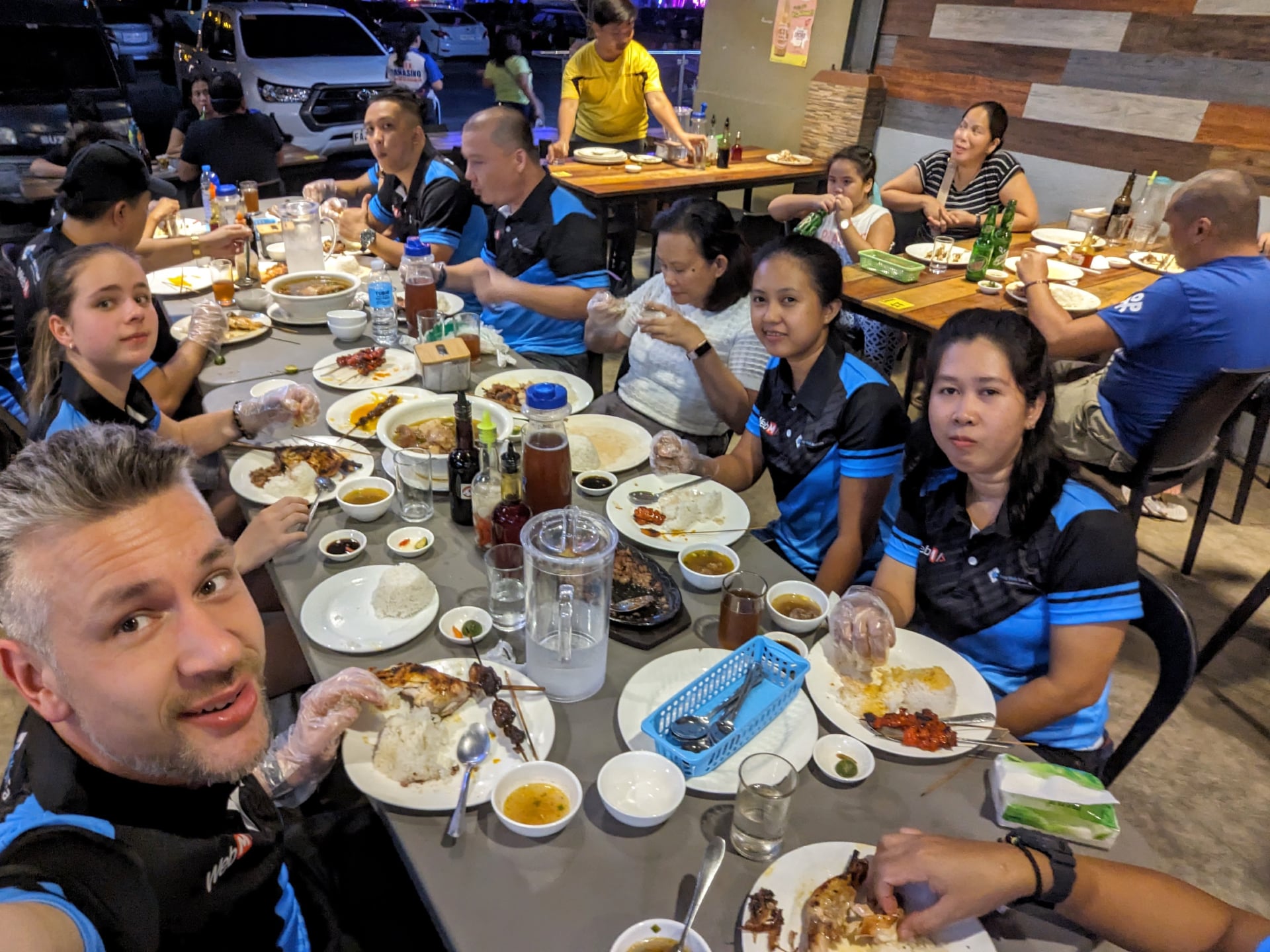
The heart of our Digital Core: Sharing a meal and finding clarity with our team in the Philippines.
In my recent visit to our team in the Philippines, I was reminded that the most powerful ‘Human Prompting’ doesn’t happen via a screen. It happens when you look someone in the eye and build the trust necessary to solve complex problems together. In 2026, proximity is the ultimate premium.
I’m focused on building that clarity — for my team, for our agencies, and for every partner we work with. Because at the end of the day, the tech is just code.
The relationship? That’s the real core.